
What Does New Kitchen Cabinets and Countertops Cost?
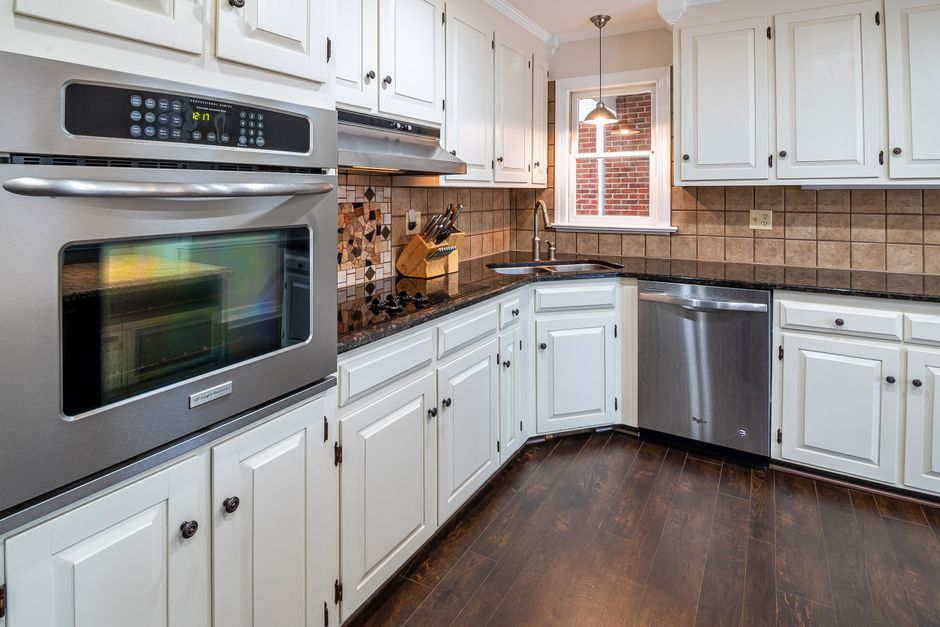
New kitchen cabinets and countertops cost about $6,000–$25,000 combined for many projects, before layout changes or major repairs. That planning range combines typical cabinet installation and countertop replacement costs; actual totals depend on cabinet grade, counter area, removal, cutouts, and reconnections. Use a written, itemized quote to compare the same materials, measurements, and work.
How much should I budget to replace both my kitchen cabinets and countertops?
Budget roughly $6,000–$25,000 for a combined replacement, using published installation ranges as a starting point rather than a guaranteed package price. Angi reports cabinet installation of $1,935–$10,769 for most full-kitchen projects and countertop replacement of $1,881–$4,484. Adding the low ends and high ends gives about $3,816–$15,253 before every project-specific add-on; higher-grade cabinets and extra work can push the total beyond that calculation.
Those figures are not perfectly comparable: cabinet installation prices and countertop replacement prices can include different scopes. A separate cabinet price table gives stock cabinets at $100–$300 per linear foot, semi-custom at $150–$650, and custom at $500–$1,200, according to Fixr. The countertop range changes with material, area, edges, and location.
Use this worksheet to make the estimate transparent. Fill it with the quantities from the contractor’s measurement and keep allowances distinct from fixed prices.
| Cost line | What to record | Published reference |
|---|---|---|
| Cabinets | Linear feet, grade, construction, specialty units | Stock $100–$300/linear foot; semi-custom $150–$650; custom $500–$1,200 |
| Countertops | Square feet, material, edge, seams | $1,000–$4,500 for 20–30 sq. ft.; $1,500–$6,000 for 30–40 sq. ft. |
| Installation | Cabinet and countertop labor shown separately | Cabinet installation averages $6,191 at Angi; countertop replacement averages $3,160 at HomeAdvisor |
| Removal and disposal | Old cabinets and counters listed separately | Countertop removal/disposal $50–$300; cabinet removal/haul-away $350–$1,000 |
| Cutouts and reconnections | Sink, cooktop, plumbing, electrical | Sink cutouts $100–$300; cooktop cutouts $120–$400 |
Published averages are reference points, not amounts to add blindly. An installation figure may overlap with another line in a contractor’s quote, so ask what each amount includes before totaling.
What would new cabinets and countertops cost in a 10x10 kitchen?
A 10x10 kitchen does not have one dependable combined price because the room’s footprint does not tell you its cabinet length or countertop area. Angi classifies small kitchens as 10–15 linear feet of cabinets; HomeAdvisor’s countertop table prices 20–30 square feet at $1,000–$4,500 installed. Those quantities offer a starting scenario, not a measurement of every 10x10 layout.
For a small-kitchen planning example, pair 10–15 cabinet linear feet with 20–30 square feet of countertop. At stock cabinet rates, the cabinet material line works out to $1,000–$4,500; the countertop line is $1,000–$4,500 installed, before any removal or separately billed work. This illustrates how a modest footprint can still span a wide range based on grade and scope.
For a medium kitchen, Angi’s 20–30 cabinet linear feet and HomeAdvisor’s 30–40 square feet of counter area produce a $2,000–$9,000 stock-cabinet material range and a $1,500–$6,000 installed countertop range. A larger or custom kitchen with 35 or more linear feet of cabinets needs a project-specific counter measurement; Angi lists island tops at 12–30 square feet, which can materially change the counter quantity.
Houzz provides a useful scale check, not a cabinets-and-counters quote. In its 2025 U.S. Houzz & Home Study, median spending on major remodels of small kitchens under 200 square feet was $35,000 in 2024; large kitchens had a $55,000 median. Houzz defines a major kitchen remodel as replacing at least all cabinets and appliances, so those totals cover a broader project. The study surveyed registered Houzz users about 2024 activity and its figures are not inflation-adjusted.
How much do cabinet quality and countertop material change the total price?
Cabinet grade alone can shift the cabinet line by thousands of dollars because per-foot ranges overlap but rise sharply at the custom end. Angi lists $100–$300 per linear foot for stock, $200–$650 for semi-custom, and $500–$1,200 for custom cabinets; Fixr lists $100–$300, $150–$650, and $500–$1,200, respectively. The sources differ on the semi-custom lower bound, so use the contractor’s product specification rather than a label alone.
Construction, layout, and specialty units also matter. Angi notes that cabinet size, layout, and style drive the final total. A quote should state the cabinet footage, construction, finish, fillers, end panels, and any specialty units; the word “semi-custom” is not a full specification.
Countertop price depends on material and area, while edge treatments and cutouts add their own costs. HomeAdvisor’s examples put 20–30 square feet at $1,000–$4,500 and 30–40 square feet at $1,500–$6,000. For a fair comparison, ask for the exact material, measured square footage, edge profile, seam plan, and cutout count rather than comparing a material allowance with a finished installation price.
Does a cabinet-and-countertop quote usually include demolition, installation, sink cutouts, and disposal?
A quote does not establish that these tasks are included unless it names them. HomeAdvisor lists $50–$300 for countertop removal and disposal, $100–$300 for a sink cutout, and $120–$400 for a cooktop cutout; it also lists edge treatments at $10–$60 per linear foot. Fixr estimates old cabinet removal and haul-away at $350–$1,000.
Ask for each scope item explicitly: cabinet removal, countertop removal, disposal, cabinet installation, countertop fabrication and installation, sink and cooktop cutouts, seams, edge work, backsplash, and plumbing or electrical reconnections. Angi says extra cutouts, seams, corners, removal, disposal, and reconnections can add costs; it puts removal, disposal, and reconnections at $200–$600 or more in some cases.
Sequence affects the risk of rework. The cabinets need to be installed and checked for level and support before the countertop is templated and installed. Ask who corrects uneven cabinets or adds reinforcement, and whether that work is included. Confirm who reconnects the sink plumbing after the new top is in place; a countertop installation line does not by itself answer that question.
Compare bids with the same checklist:
- Cabinet linear footage, grade, construction, finish, and specialty units.
- Countertop material, measured area, edge profile, seams, and backsplash.
- Sink and cooktop cutouts, plus any extra corners or fabrication.
- Removal and disposal for both old cabinets and countertops.
- Cabinet leveling or reinforcement before templating.
- Who reconnects plumbing and electrical, and which costs are excluded.
Low totals can reflect fewer included tasks. Keep allowances, exclusions, and possible add-ons visible beside the bid total.
Frequently Asked Questions
What extra costs can appear after cabinets and countertops are measured or removed?
Removal and disposal, sink or cooktop cutouts, edge treatments, seams, and plumbing or electrical reconnections can add charges. Ask for each as a separate line item and confirm what could change after final measurement.
How can I compare quotes when contractors include different materials and labor?
Put each quote on the same worksheet: cabinet linear feet and grade, countertop square feet and material, installation, removal, cutouts, seams, backsplash, disposal, and reconnections. Compare totals only after the inclusions and exclusions match.
Can I save money by buying cabinets myself or keeping the existing kitchen layout?
Stock or ready-to-assemble cabinets and a simpler countertop edge are ways to reduce material or fabrication costs. Keeping the existing layout avoids treating a cabinet-and-countertop replacement as a broader redesign, but confirm who measures, installs, and handles delivery or damage.
Sources
Read next
What Are the Best New Kitchen Cabinets Ideas?
New kitchen cabinets ideas work best when finishes suit your counters and floors and storage fits your daily routine.
How Do I Choose the Best Front Door for My Home?
Choose a front door by matching style, glazing, climate ratings, frame condition, and installation needs to your home.

Can I Finance a Used Car With Zero Down Payment?
A practical guide to qualifying for a zero-down used-car loan, comparing offers, and avoiding costly negative equity.

Can a Convertible Sofa Bed Work as Your Everyday Primary Bed?
How to judge whether a convertible sofa bed can deliver daily sleep comfort, support, room fit, and durable folding performance.