
How Do I Choose New Kitchen Cabinets and Countertops?
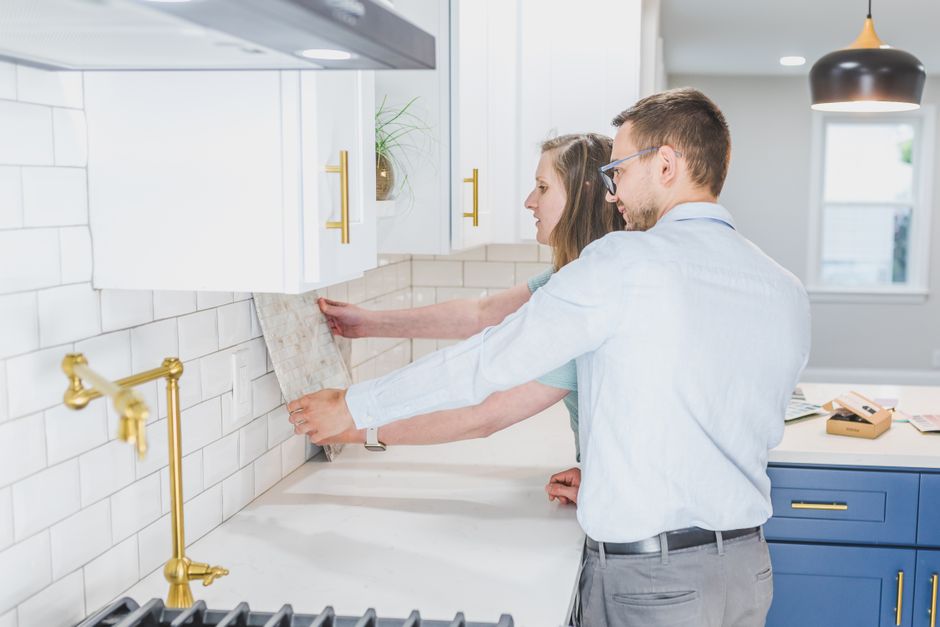
Choose new kitchen cabinets and countertops as a pair: coordinate their undertones, let one finish carry more visual pattern, and compare physical samples together in your kitchen. Check them in daylight and under your installed lighting, because LEDs and showroom fixtures can change how whites, grays, and other finishes appear. Confirm the combination before ordering, when a mismatch is easier to correct.
How do I choose new kitchen cabinets and countertops that look good together?
Choose new kitchen cabinets and countertops that look good together by making the relationship between the finishes deliberate: align their undertones, balance their patterns, and judge them in the room where they will be used. A cabinet color and a counter that each look appealing alone can feel wrong side by side if one reads warm and the other cool, or if both have strong visual movement.
Use a simple lead-and-support rule: let either the cabinet or countertop be the more noticeable finish, and let the other give it room. With detailed door fronts, a visually quieter counter can keep the composition from becoming crowded. With plain cabinet fronts, a more expressive counter can add pattern without competing with door details. These are starting points, not fixed rules; the full-size samples decide.
Make the comparison in the kitchen, not just at the showroom desk. The peer-reviewed study by Szabó and colleagues describes visual experiments in a full-scale kitchen and dining room, supporting the practical value of judging finishes in a residential setting. Place the cabinet and counter samples together, then look at them from the main viewpoints in the room.
Before ordering, use this checklist:
- Shortlist a few combinations. Keep options that suit the room and your preferred level of contrast.
- Put the actual samples together. Compare cabinet color, counter pattern, and the amount of visual activity across both surfaces.
- Check the light. Look in daylight, then turn on the kitchen's installed fixtures, including under-cabinet lights if they are part of the plan.
- Choose the lead finish. State which surface should draw more attention and confirm the other supports it.
- Recheck before purchase. Review the exact selected samples together before approving the order.
That last check matters because cabinets and countertops are commonly updated in the same renovation. Houzz's 2024 U.S. Kitchen Trends Study reports that 85% of renovating homeowners upgraded cabinets and 91% upgraded countertops. Both are large visual decisions, so a sample review is a practical checkpoint before committing.
Should I choose cabinet color or countertop first?
Choose first the finish that is harder for you to change or that will set the strongest direction for the room, then select the second finish against it. There is no universal order that works for every kitchen; the useful move is to make one selection the anchor rather than choosing each finish in isolation.
If a particular countertop pattern or material is driving the design, use it as the anchor and bring cabinet samples to it. If the cabinet color or door style is already set, take that sample to the countertop selection instead. In either case, reserve the final decision until you have compared both finishes in the same light.
Keep the financial stakes in perspective without treating one estimate as a personal budget. Harvard's Joint Center for Housing Studies reported average homeowner spending of $13,445 for kitchen remodels in 2021, with average spending of $6,878 for minor remodels and $47,773 for major remodels. Those figures describe different project scopes, but they show why a coordinated sample check belongs before an order is placed. For broader project planning, see What Does New Kitchen Cabinets and Countertops Cost?
Use this decision phrase when you are stuck: “This is the anchor finish; the other choice needs to support it in daylight and under our kitchen lights.” If neither finish is clearly the anchor, compare the samples with the pattern rule: keep the stronger visual movement in one surface and simplify the other.
How can I tell whether cabinet and countertop undertones clash?
You can spot a likely undertone clash by placing the samples together and checking whether one appears noticeably warmer or cooler than the other, especially when you switch between daylight and the kitchen's electric lights. Whites and grays are not automatically neutral matches; their appearance depends partly on the light and on how the surfaces reflect it.
The U.S. Department of Energy explains that correlated color temperature, or CCT, describes the apparent color of the light source—not the color of the objects it illuminates. Color rendering depends on the light's spectral power distribution and the surfaces' reflectance, and lighting can affect an object's hue, saturation, and lightness. In practical terms, a label on a bulb cannot tell you exactly how a white cabinet or gray countertop will look in your kitchen.
DOE also notes that two LEDs with the same CCT and color rendering index, or CRI, can still render colors differently. It describes CRI in the 80s as generally good for interior applications and in the 90s as excellent, while noting that CRI has limits and works as a rough guide. So check the actual finish under the actual fixture when possible. Do not rely on a showroom's bright display lights to predict the look at home.
Lighting deserves a place in the finish decision, not an afterthought. In NKBA's 2027 kitchen trends findings, 84% of surveyed designers agreed kitchens would incorporate multiple layers of lighting, and 87% expected under-cabinet lighting to be popular. If your kitchen will have layered or under-cabinet lights, compare samples with those lights on as well as with the main fixtures. A sample that seems compatible in one condition may read differently in another.
For a clear pass-or-pause test, place the samples together and ask: “Do these still look like a deliberate pair in daylight and in our installed lighting?” If one finish suddenly looks yellow, blue, pink, or dull beside the other, pause and compare another option. That is a reason to inspect further, not proof that a specific pairing can never work.
Frequently Asked Questions
Will a countertop sample look the same at home as it does in the showroom?
Not necessarily. Showroom and home lighting can render colors differently, and even LEDs with the same color temperature and CRI can show finishes differently. Check the sample at home in daylight and under the lighting you plan to use.
How many cabinet and countertop samples should I compare?
There is no source-backed standard number. Start with a manageable shortlist of complete combinations, then compare each cabinet sample beside each countertop sample in the kitchen. Keep only the combinations that work in both daylight and installed lighting.
What countertop pattern works best with plain or detailed cabinet doors?
A useful starting point is to pair detailed doors with a quieter countertop, or plain doors with a countertop that adds more pattern. This gives one surface the lead and helps prevent competing details from making the room feel busy.
Sources
Read next
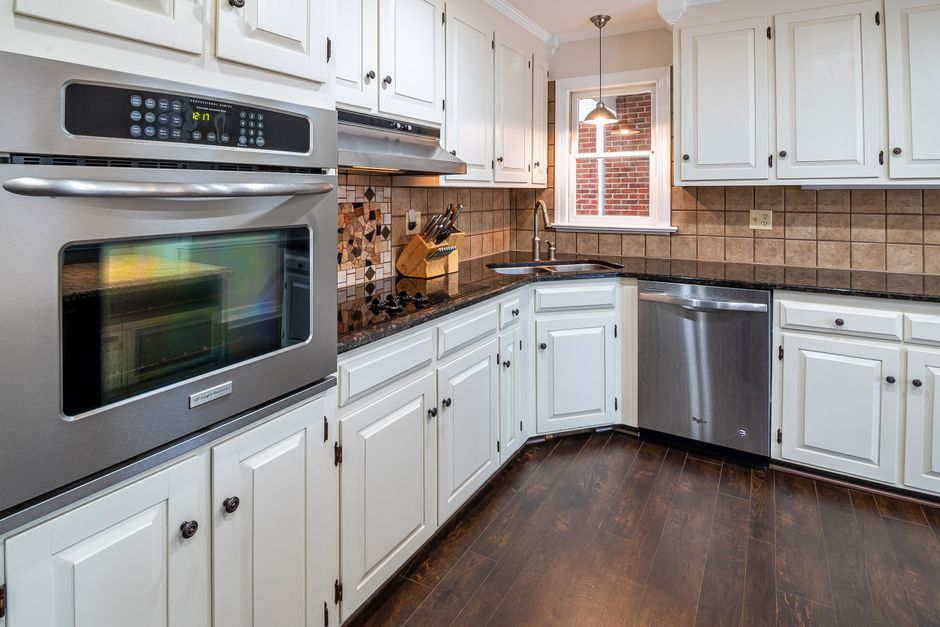
What Does New Kitchen Cabinets and Countertops Cost?
New kitchen cabinets and countertops cost about $6,000–$25,000 combined, before layout changes or major repairs.
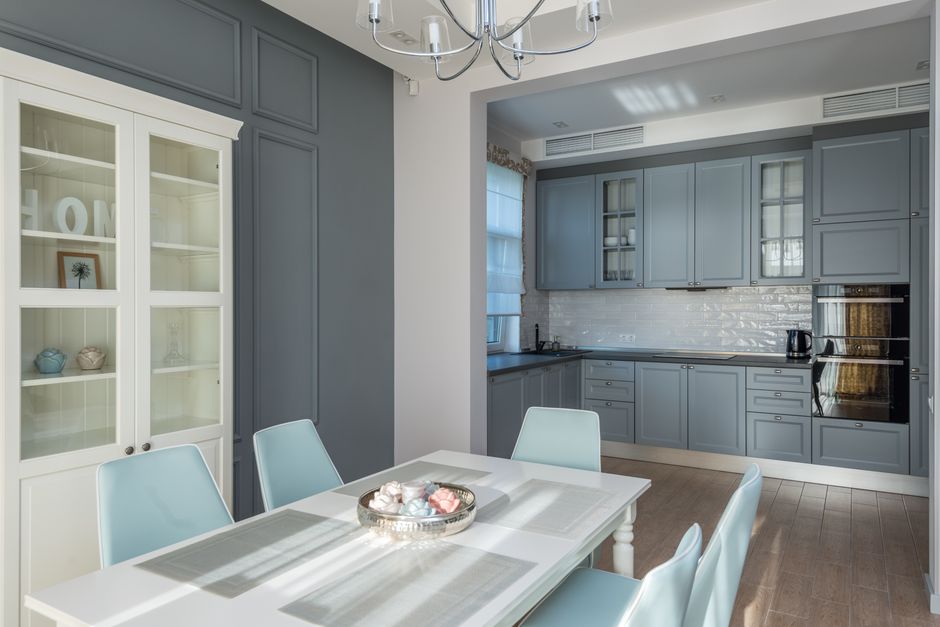
What Are the Best New Kitchen Cabinets Ideas?
New kitchen cabinets ideas work best when finishes suit your counters and floors and storage fits your daily routine.
How Do I Choose the Best Front Door for My Home?
Choose a front door by matching style, glazing, climate ratings, frame condition, and installation needs to your home.

Can I Finance a Used Car With Zero Down Payment?
A practical guide to qualifying for a zero-down used-car loan, comparing offers, and avoiding costly negative equity.